What Makes a Cat Hypoallergenic?
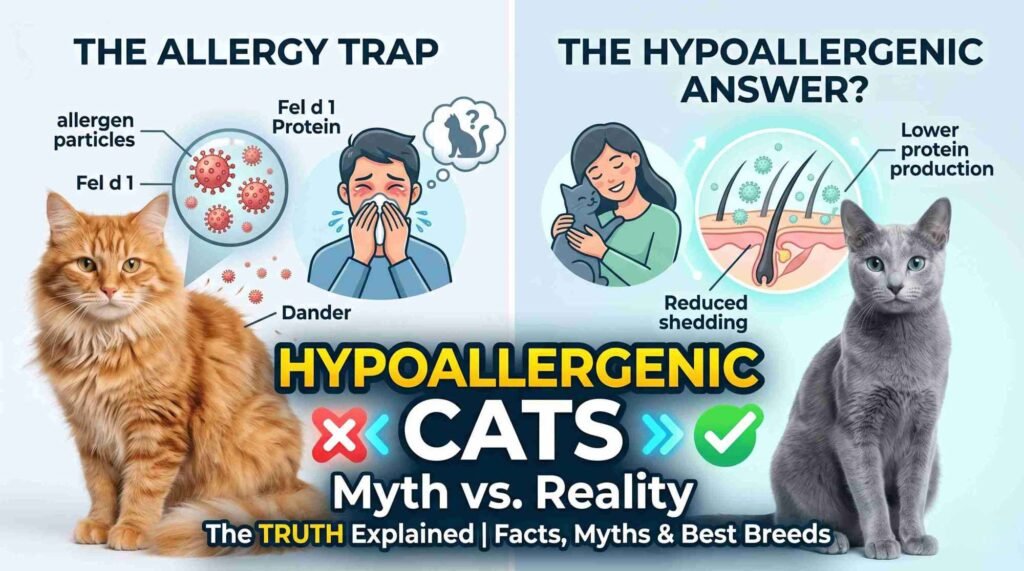
The term hypoallergenic cat does not mean allergy-free. It means a cat that produces fewer or lower-potency allergens, reducing the likelihood of triggering a reaction. Research published in the Journal of Feline Medicine and Surgery confirms that cat allergy affects 5–20% of the general population and up to 30% of individuals with pre-existing respiratory allergies.
The primary culprit behind cat allergies is a protein called Fel d 1 (Felis domesticus allergen 1). It is produced in a cat’s salivary glands, sebaceous (skin oil) glands, perianal glands, and tear ducts. When cats groom, the protein coats the fur, dries into microscopic flakes, and becomes airborne — settling on furniture, bedding, clothing, and even surfaces far from where the cat lives.
Around 90–96% of cat-allergic individuals are sensitized specifically to Fel d 1, according to peer-reviewed data. The protein is remarkably stable: it can remain active in household environments for months and has been detected in schools, offices, and public transport — even in homes that have never housed a cat. This persistence makes choosing a low-allergen breed and maintaining smart grooming habits the two most impactful strategies for allergy management.
- Salivary Glands — 45%
- Sebaceous Glands — 30%
- Perianal Glands — 15%
- Lacrimal (Tear) Glands — 10%
Factors That Influence Allergen Levels
Not all cats produce the same amount of Fel d 1. Research shows natural variation of over 100-fold between individual cats, even within the same breed. Several biological and lifestyle factors directly influence allergen output in hypoallergenic cat breeds.
Best Hypoallergenic Cat Breeds
The following hypoallergenic cat breeds are recommended by veterinarians and allergy specialists for people with mild to moderate sensitivities. Each breed either produces lower quantities of Fel d 1 or sheds significantly less, limiting the spread of allergens throughout your home. If you want to explore specific breed spotlights, our veterinary team covers temperament, health, and care needs in detail.
Siberian
Despite a thick, triple-layered coat, the Siberian is one of the most well-documented low-allergen cats. Some studies indicate up to 75% of allergy sufferers show zero reaction to Siberians, attributed to naturally low Fel d 1 production.
Balinese
Called the “long-haired Siamese,” the Balinese produces significantly less Fel d 1 than most other breeds. Affectionate, vocal, and social — it is a top choice for allergy-prone families who want a loving companion.
Russian Blue
Russian Blues have a dense, plush double coat but are known to produce lower Fel d 1 levels. Their reserved, gentle nature and minimal shedding also means allergens spread less throughout the home.
Sphynx
The hairless Sphynx still produces Fel d 1 — but without fur to trap and spread it, allergen dispersal is significantly reduced. They require regular baths to manage skin oil build-up, which helps limit allergen exposure.
Devon Rex
The Devon Rex has a short, curly, low-shedding coat that keeps dander from becoming airborne. They are highly social and playful, making them a great fit for active families managing cat allergies.
Cornish Rex
Like the Devon Rex, the Cornish Rex has a soft, wavy, minimal-shedding coat. Both Rex breeds are virtually shed-free by feline standards, dramatically reducing the volume of allergen-carrying fur in the environment.
Oriental Shorthair
A close relative of the Siamese, the Oriental Shorthair has a silky, fine coat that sheds minimally. They are known to produce lower Fel d 1 and are an excellent choice for those drawn to elegant, slender cat breeds.
Bengal
Bengals have short, pelt-like coats that require minimal grooming and shed very little. While not the absolute lowest in Fel d 1 production, their low-shed coat structure keeps airborne allergens to a minimum.
Hypoallergenic Cat Breed Comparison
The table below compares the most popular hypoallergenic cat breeds across the key criteria allergy sufferers consider most when choosing a feline companion.
| Breed | Coat Type | Fel d 1 Level | Shedding | Grooming Need | Allergy-Friendly |
|---|---|---|---|---|---|
| Siberian | Long, triple-coat | Very Low | Moderate | Medium | ⭐⭐⭐⭐⭐ |
| Balinese | Long, silky | Very Low | Low | Medium | ⭐⭐⭐⭐⭐ |
| Russian Blue | Short, dense double | Low | Low | Low | ⭐⭐⭐⭐½ |
| Sphynx | Hairless / sparse | Moderate | None | High (bathing) | ⭐⭐⭐⭐ |
| Devon Rex | Short, curly | Low–Mod | Very Low | Low | ⭐⭐⭐⭐ |
| Cornish Rex | Short, wavy | Low–Mod | Very Low | Low | ⭐⭐⭐⭐ |
| Oriental Shorthair | Short, fine | Low | Low | Low | ⭐⭐⭐⭐ |
| Bengal | Short, pelt-like | Moderate | Low | Low | ⭐⭐⭐½ |
How to Reduce Cat Allergens at Home
Choosing a low-allergen cat breed is only part of the solution. Environmental management is equally important. Allergy-proofing your home can reduce Fel d 1 exposure by 50–70%, making it possible for moderate allergy sufferers to comfortably live with a cat. For cat-specific health concerns, see our guide on cat illness prevention.
Regular Grooming
Brush your cat 2–3 times per week, ideally outdoors or in a ventilated area. Weekly bathing reduces surface Fel d 1 significantly.
HEPA Air Filters
Run HEPA-certified air purifiers in bedrooms and living areas. Replace filters on schedule — allergen-loaded filters re-circulate particles.
Cat-Free Bedroom
Keeping cats out of the bedroom is the single most impactful intervention for allergy sufferers who spend 8 hours sleeping.
Vacuum Weekly
Use a HEPA vacuum on carpets and upholstery. Hard floors trap fewer allergens and are easier to clean thoroughly.
Anti-Fel d 1 Diet
Specialized cat foods containing anti-Fel d 1 egg antibodies have been clinically shown to reduce active allergen on fur by up to 47%.
Wash Hands Always
Wash hands thoroughly after petting and avoid touching your face. This simple habit prevents direct mucous-membrane allergen transfer.
Does Cat Gender Affect Allergies?
Yes — significantly. Female cats produce notably less Fel d 1 than intact males. Neutered males fall between the two, producing substantially less than intact males. This distinction matters when selecting a hypoallergenic cat for a highly sensitive individual.
✅ Lower Allergen Producers
- Female cats (spayed or intact)
- Neutered male cats
- Kittens (very young cats)
- Low-allergen diet-fed cats
- Regularly bathed cats
⚠️ Higher Allergen Producers
- Intact adult male cats
- Older unneutered males
- Stressed or anxious cats (more grooming)
- Persian, Maine Coon, Norwegian Forest Cat
- Cats fed standard diets
Common Myths About Hypoallergenic Cats
Misinformation about hypoallergenic cat breeds is widespread, leading many allergy sufferers to make costly or disappointing choices. These are the most important myths to understand before adopting.
Latest Research on Cat Allergen Management
The science of hypoallergenic cats and allergen management is advancing rapidly. For allergy sufferers, these developments offer genuine hope beyond simply choosing a low-allergen breed. For broader cat health context, read our article on cat health warning signs.
Anti-Fel d 1 Antibody Cat Food
A 2019 clinical study published in Allergy (Wiley) demonstrated that feeding cats a diet supplemented with egg antibodies specifically targeting Fel d 1 reduced active allergen on cat hair and dander by up to 47%. This approach modifies the allergen’s activity rather than suppressing the cat’s production entirely — an important welfare-safe distinction.
CRISPR Gene Editing
Researchers analyzing Fel d 1 sequences from over 50 domestic cats identified conserved gene regions suitable for CRISPR editing. Published in The CRISPR Journal, the study found that the protein shows remarkable genetic diversity, suggesting it may not be essential to cat survival — a finding that makes gene-editing approaches ethically and practically viable for future research.
Allergen Immunotherapy
Subcutaneous and sublingual immunotherapy for cat allergy remains the most clinically validated long-term treatment. Phase III trials of Cat-PAD (a peptide allergen desensitization therapy targeting Fel d 1) have shown persistent treatment effects 12+ months after dosing began. Managing your pet’s health proactively alongside your own allergy treatment delivers the best outcomes.
| Intervention | Allergen Reduction | Evidence Level | Practical? |
|---|---|---|---|
| Select low-Fel d 1 breed | Up to 75% (Siberian studies) | High | ✅ Yes |
| Neuter male cat | ~50% Fel d 1 drop | High | ✅ Yes |
| Anti-Fel d 1 diet | Up to 47% | High (RCT) | ✅ Yes |
| HEPA air purifier | Significant airborne reduction | Moderate | ✅ Yes |
| Weekly bathing | ~25% | Moderate | ⚠️ Breed-dependent |
| Allergen immunotherapy | Long-term desensitization | Very High | ✅ Yes (medical) |
| CRISPR gene editing | Potentially 90%+ | Early Research | ❌ Not yet available |
What to Do Before Adopting a Hypoallergenic Cat
Bringing home a hypoallergenic cat without preparation can lead to disappointment — and hardship for both you and the cat. These steps help ensure a successful adoption for allergy-prone families.
Step 1: Get Allergy Tested
An allergist can confirm whether Fel d 1 is your primary trigger or whether other allergens (dust mites, mold, Fel d 4 lipocalin) are contributing to your symptoms. This prevents misattributing ongoing symptoms to your new cat.
Step 2: Spend Time With the Breed First
Visit a reputable breeder or a friend who owns the specific breed. Spend at least 30–60 minutes in the same room on multiple occasions before deciding. Individual Fel d 1 variation means even within a breed, one cat may suit you better than another.
Step 3: Prepare Your Home
Install HEPA air purifiers before the cat arrives. Reduce upholstered surfaces in the main living area. Choose hard flooring where possible, or use low-pile rugs that are easy to clean. Designate sleeping areas as cat-free zones from day one.
Step 4: Plan Your Grooming Routine
Establish a grooming schedule appropriate for the breed you choose. For higher-maintenance coats like the Siberian, weekly brushing and occasional bathing become part of your routine. Consistent grooming is non-negotiable for allergy management. Learn more about pet health and wellness routines on Vetiana.