
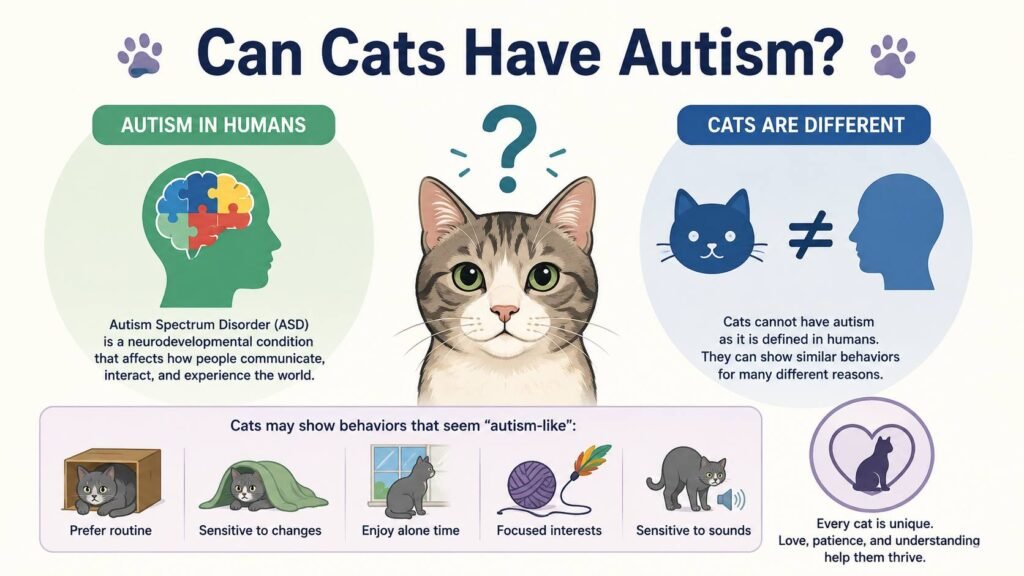
If you are a cat owner who has ever watched your feline companion pace the same path repeatedly, shrink away from strangers, or seem oddly indifferent to social overtures, you have probably asked yourself: Is something neurologically different about my cat? The phrase “cat autism” has gained enormous traction online, and it is a genuinely important question — not just out of curiosity, but because understanding the root of these behaviors shapes how you care for your pet. The answer is both scientifically precise and practically nuanced, and it deserves a thorough explanation.
Cats cannot be formally diagnosed with Autism Spectrum Disorder (ASD) — a condition defined exclusively within human neurodevelopmental criteria. However, some cats display behaviors that closely parallel autism traits, including repetitive movements, sensory hypersensitivity, and social avoidance. These behaviors have distinct feline causes, and understanding them is critical for proper veterinary care.
What Is Autism Spectrum Disorder?
Autism Spectrum Disorder (ASD) is a complex neurodevelopmental condition in humans, characterized by the DSM-5 (Diagnostic and Statistical Manual of Mental Disorders) as persistent differences in social communication, repetitive behavioral patterns, and atypical sensory responses. The “spectrum” is broad — individuals may range from highly verbal and independent to those requiring significant daily support.
ASD is currently diagnosed in approximately 1 in 36 children in the United States (CDC, 2023), and its understanding has grown dramatically over the past two decades. The diagnostic framework relies on human cognition, language, and social structures that simply do not translate directly to animals — which is precisely why the concept of “feline autism” is scientifically complicated.
Can Cats Have Autism? The Scientific Verdict
The straightforward scientific answer is no — cats cannot have autism as it is defined for humans. Autism is a diagnosis built around human neurological structures, language-based communication deficits, and human social reciprocity. Cats lack the cognitive and communicative architecture that ASD disrupts in people. There are no established veterinary diagnostic criteria for feline ASD, and no peer-reviewed research has formally classified autism in domestic cats.
However, the conversation does not end there. Cats — like all complex mammals — have individual neurological variation. Some cats exhibit behavioral patterns that, to a human observer familiar with autism, can look remarkably similar. Veterinary behaviorists use the term “autism-like behaviors” or “feline neurodevelopmental atypicalities” to describe these presentations, while firmly distinguishing them from human ASD.
- Cats can display repetitive, stereotypic behaviors
- Some cats show extreme sensory hypersensitivity
- Social withdrawal can be a real feline behavioral pattern
- Certain breeds have higher rates of atypical behavior
- Genetics and early environment shape feline neurodevelopment
- Cats benefit children with ASD therapeutically (research-proven)
- Cats cannot be formally diagnosed with ASD
- No veterinary DSM equivalent exists for feline autism
- Social aloofness ≠ autism; it is often normal independence
- Repetitive grooming ≠ autism; it often signals anxiety or OCD
- No imaging or genetic test confirms “cat autism”
- Human autism traits cannot be directly mapped to cat behavior
Autism-Like Behaviors in Cats: What to Actually Look For
While “cat autism” is not a medical diagnosis, certain behavioral profiles in cats can genuinely concern owners and warrant veterinary attention. These behaviors, when persistent and distressing, may reflect underlying feline neurodevelopmental variation, anxiety disorders, obsessive-compulsive disorder (OCD), or sensory processing differences rooted in neurological or medical causes.
Excessive pacing, tail-chasing, spinning, or repetitive vocalizations that appear compulsive and out of context. Often triggered by stress, boredom, or early weaning from the mother.
Consistently refusing contact with humans or other animals, hiding for extended periods, or showing marked distress when approached — beyond normal feline independence.
Extreme, disproportionate reactions to sounds, touch, light, or smells. A cat with Feline Hyperesthesia Syndrome (FHS) may ripple its skin, bite its tail, or vocalize intensely from minor stimuli.
Extreme distress when feeding times, litter placement, or home environments change even slightly — beyond typical cat routine preference. Associated with anxiety disorders.
Consistently avoiding direct gaze. In cats, direct eye contact is often a threat signal, so this may simply reflect normal feline body language rather than social deficit.
Reduced or absent vocalization in previously communicative cats, or atypical vocalizations. May indicate neurological differences or medical conditions like deafness.
Important: Many of these behaviors have well-defined medical explanations — Feline Hyperesthesia Syndrome, OCD, anxiety disorders, early developmental trauma, pain, hyperthyroidism, and neurological disease. Always consult a veterinarian before attributing these signs to “autism.” A missed medical diagnosis can mean unnecessary suffering for your cat.
Autism-Like Behaviors vs. Their Actual Feline Diagnoses
Below is a clinically oriented breakdown of behaviors commonly mistaken for feline autism, the more likely medical or behavioral diagnosis, and recommended next steps.
| Observed Behavior | Commonly Mistaken For | Actual Likely Cause | Urgency |
|---|---|---|---|
| Repetitive pacing / spinning | Autism / Stimming | Feline OCD, boredom, anxiety, or neurological disease | Moderate |
| Skin rippling / tail aggression | Sensory processing disorder | Feline Hyperesthesia Syndrome (FHS) | High |
| Social withdrawal / hiding | Autism / social deficit | Fear, past trauma, illness, or normal introversion | Moderate |
| Extreme noise sensitivity | Sensory hypersensitivity | Anxiety, partial deafness, or neurological hypersensitivity | Moderate |
| Avoiding eye contact | Autism social avoidance | Normal cat communication (gaze = threat), fear, or past trauma | Low |
| Excessive self-grooming / barbering | Repetitive / restrictive behavior | Anxiety, allergies, dermatitis, parasites, or OCD | High |
| Non-responsiveness to name | Communication deficit (autism) | Deafness, distraction, or normal feline behavior | Low |
| Aggression at being touched | Sensory defensiveness | Pain, Feline Hyperesthesia, or negative past experience | High |
| Distress at routine changes | Rigid, restricted interests | Generalized anxiety disorder or environmental stress | Moderate |
Table 1. Behavioral comparison guide. Source: Vetiana editorial review based on veterinary behavior literature.
What Does the Research Actually Say?
Although the scientific consensus is clear that cats do not have ASD, research has expanded in important directions. Most notably, the community has pivoted toward examining how cats can benefit children diagnosed with autism — a relationship with remarkable evidence behind it.
Researchers at the University of California studied cat-child interactions in families with ASD-diagnosed children. Findings suggested cats serve as calming, affectionate companions that supplement emotional regulation in affected children.
The first RCT investigated temperament-screened shelter cat adoption in families with ASD children. After 18 weeks, children showed reduced separation anxiety, fewer problem behaviors, and stronger empathy skills.
A qualitative study of six mothers with ASD children confirmed that cats provided sensory stimulation, a calming influence, and opportunities for children to practice responsibility and compassion.
A systematic review across PubMed, CINAHL, and Scopus identified 13 articles from 12 studies. Five themes emerged: suitability characteristics, human-cat bonding, cats as social substitutes, quality-of-life improvements, and ownership considerations.
Research confirmed cats may serve as a compensatory mechanism for autistic individuals who tend toward social contact avoidance — offering non-judgmental companionship without the communicative demands of human relationships.
Source: University of Missouri RCT (2021), COVID-19 qualitative study (2022), Tandfonline Scoping Review (2023), Autism Parenting Magazine (2025).
Which Cat Breeds Show More Atypical Behaviors?
While no breed has been formally diagnosed with a feline autism equivalent, certain breeds carry genetic predispositions toward behaviors that can resemble autism-like traits. This is likely a product of selective breeding affecting neurological temperament, sensory processing, and social bonding patterns.
High vocalization, extreme bonding to one person, and documented compulsive behaviors. Some show intense sensory reactivity.
Prone to OCD-like behaviors and strong routine dependency. Genetic links to compulsive wool-sucking have been studied.
High-energy, hypervigilant, and can display extreme flight responses to environmental changes — mimicking sensory sensitivity.
Strong territorial behaviors, repetitive marking, and hyperactivity can be confused with atypical neurological functioning.
Cats not socialized in weeks 2–7 post-birth often display permanent social avoidance that closely resembles autistic traits.
Feline Hyperesthesia Syndrome: The Closest Clinical Parallel
Among all conditions veterinary medicine recognizes in cats, Feline Hyperesthesia Syndrome (FHS) — sometimes called “rolling skin disease” — bears the closest surface resemblance to certain autism-related sensory processing differences. It is a real, documented neurological condition characterized by extreme skin hypersensitivity, self-directed aggression, frantic running, and altered states of consciousness.
| Feature | Feline Hyperesthesia Syndrome (FHS) | Human ASD Sensory Processing Issues |
|---|---|---|
| Primary Mechanism | Neurological hypersensitivity of skin/spinal reflex arcs | Atypical sensory integration in CNS processing |
| Trigger | Touch along the spine, stress, environmental changes | Variable — sensory overload in different modalities |
| Behavioral Response | Skin rippling, tail biting, vocalization, frantic running | Meltdowns, self-stimulatory behavior, withdrawal |
| Diagnosis | Clinical exam, ruling out dermatitis, allergies, seizure disorder | DSM-5 behavioral criteria in humans |
| Treatment | Anti-anxiety medication, environmental enrichment, gabapentin | Occupational therapy, behavioral interventions, sometimes medication |
| Prognosis | Manageable with support; rarely fully resolved | Lifelong condition with varying support needs |
Table 2. FHS vs. human ASD sensory features. Source: Vetiana editorial, synthesized from veterinary neurology literature.
Cats as Therapy Animals for Children with Autism
One of the most robust and well-researched aspects of this topic is the role cats play as therapeutic companions for children diagnosed with ASD. Cats possess natural characteristics uniquely suited to households with autistic children: they are quieter than dogs (critical for auditory hypersensitivity), smaller and less physically overwhelming, and their behavior is more consistent and predictable. Research from Missouri University’s College of Veterinary Medicine found that after cat adoption, children with ASD showed more empathy, reduced separation anxiety, and fewer disruptive behaviors.
Source: Autism Parenting Magazine (2025), synthesized from multiple qualitative and quantitative studies.
When Should You Consult a Veterinarian?
If your cat displays any of the behaviors discussed above in a persistent, distressing, or worsening pattern, a veterinary consultation is always the right first step. There is no clinical test for “cat autism,” but a thorough examination can rule out medical causes, identify behavioral disorders, and open the door to effective management strategies.
| Symptom Pattern | Who to Consult | Diagnostic Approach | Management Options |
|---|---|---|---|
| Repetitive pacing, spinning, tail-chasing | General vet + behaviorist | Neurological exam, behavioral history, video documentation | Environmental enrichment, anti-anxiety medication (fluoxetine, clomipramine) |
| Skin rippling, self-directed aggression | Veterinary neurologist | MRI, skin biopsy, EEG if seizures suspected | Gabapentin, phenobarbital, behavioral modification |
| Extreme social withdrawal, hiding | General vet first | Full physical exam, bloodwork, thyroid panel | Feliway pheromone therapy, safe space creation, gradual desensitization |
| Severe sensory hypersensitivity | Veterinary behaviorist | Behavioral assessment, rule out pain sources | Desensitization protocols, anti-anxiety treatment, sensory modification |
| Compulsive overgrooming (alopecia) | Dermatologist + behaviorist | Skin culture, allergy testing, parasite screen | Address underlying trigger, behavioral therapy, medication if needed |
Table 3. Veterinary consultation guide for autism-like behaviors in cats. Source: Vetiana, compiled from ASPCA, AAFP, and ACVB behavioral guidelines.
When a cat owner tells me their cat “might have autism,” I take the concern seriously — not because autism is a feline diagnosis, but because it tells me the cat is showing behavior that is distressing to both animal and owner. The clinical priority is ruling out pain, neurological disease, and endocrine disorders first. Once medical causes are cleared, a certified animal behaviorist becomes an indispensable partner. Early intervention always leads to better outcomes.
How to Care for a Cat with Autism-Like Behaviors
Regardless of whether your cat has a formal diagnosis, managing a cat with atypical, anxiety-driven, or sensory-sensitive behaviors follows well-established principles rooted in behavioral medicine and environmental psychology.
Quiet retreats — elevated perches, enclosed boxes, dedicated corners where they feel protected. Consistency in these spaces is critical. Never force interaction.
Feed, play, and interact with your cat at the same times daily. Routine predictability dramatically reduces baseline anxiety in cats with sensory and behavioral sensitivities.
Puzzle feeders, wand toys, window perches, and climbing structures address boredom-driven repetitive behaviors and provide essential mental stimulation.
Feliway Classic (synthetic feline facial pheromone) has evidence-based support for reducing anxiety, aggression, and marking behaviors. Diffusers and sprays work well near problem areas.
Use positive reinforcement with high-value treats. Allow the cat to initiate contact. Short, calm sessions over weeks can meaningfully improve social comfort in previously avoidant cats.
For cats with OCD, severe anxiety, or FHS not responding to behavioral interventions, medications such as fluoxetine, gabapentin, or buspirone are well-studied and often highly effective.
Source: ACVB consensus guidelines; AAFP Feline Behavior Guidelines 2024.
Frequently Asked Questions
No. There is no official veterinary diagnosis for feline autism. Autism Spectrum Disorder is a human neurodevelopmental condition defined by human-specific criteria. No governing veterinary body — including the AVMA, ACVB, or AAFP — recognizes feline ASD as a diagnosis.
Feline Hyperesthesia Syndrome (FHS) and feline OCD are most commonly confused with autism in cats. FHS causes extreme skin sensitivity, self-directed aggression, and altered states. Feline OCD produces compulsive repetitive behaviors such as excessive grooming, pacing, and vocalization. Both have clinical diagnoses and treatment pathways.
Almost certainly not. In feline communication, sustained direct eye contact is a sign of aggression or challenge — not social connection. Cats naturally avoid prolonged eye contact. Ignoring a name is also normal; cats are not trained to respond to names the way dogs are. Neither behavior indicates autism unless accompanied by other significant signs.
Yes — multiple peer-reviewed studies support cats as excellent companions for children with ASD. Cats are quiet, physically non-threatening, and offer predictable, calm companionship. A 2021 RCT found that ASD children who adopted temperament-screened shelter cats showed measurably reduced anxiety, more empathy, and fewer problem behaviors over 18 weeks.
Excessive grooming leading to hair loss (psychogenic alopecia) is almost always caused by anxiety, stress, allergies, parasites, or feline OCD — not autism. It requires prompt veterinary attention. Anti-anxiety medication and environmental modification are typically very effective when started early.
Yes, significantly. Kittens have a critical socialization window between weeks 2 and 7 of life. Inadequate socialization, early weaning, trauma, or neglect during this period can produce lasting behavioral patterns closely resembling autism traits. These are trauma-based behavioral adaptations — real, clinically significant, and often manageable with patient behavior therapy.
Siamese and Burmese cats have the most documented genetic predisposition toward compulsive, repetitive, and atypical social behaviors. Bengals and Abyssinians may also display hyperactive or hypersensitive profiles. Individual variation within breeds is enormous, and breed alone is never sufficient to explain behavioral differences.
No test for feline autism exists because feline autism is not a recognized medical diagnosis. However, a veterinarian can perform a comprehensive clinical examination, neurological assessment, bloodwork, thyroid panel, and behavioral history review. A certified veterinary behaviorist (DACVB) can conduct a detailed behavioral assessment to identify real, treatable conditions.
Final Verdict: What Every Cat Owner Should Know
The science is clear: cats cannot be diagnosed with Autism Spectrum Disorder. ASD is a human neurodevelopmental condition with human-specific diagnostic frameworks, and no equivalent has been established in veterinary medicine. However, this does not mean that cats with unusual behaviors should be dismissed. Real, diagnosable conditions — from Feline Hyperesthesia Syndrome and OCD to anxiety disorders and trauma-based behavioral patterns — explain the vast majority of autism-like presentations in cats. These conditions deserve proper veterinary attention and can be meaningfully managed. On the other side of this conversation sits an equally important finding: cats are outstanding therapeutic companions for children diagnosed with autism, with peer-reviewed research confirming measurable improvements in anxiety, empathy, and social behavior. If your cat’s behavior concerns you, schedule a veterinary consultation. And if you have a child with ASD, the evidence suggests that welcoming the right cat into your home could be transformative.



I appreciate how this article separates actual Autism Spectrum Disorder from behaviors in cats that only appear similar on the surface. The section about repetitive behaviors and sensory sensitivity was especially helpful because a lot of owners may assume these traits are “just personality” instead of possible signs of stress or neurological issues worth discussing with a vet. It’s a good reminder that careful observation matters more than attaching human labels to feline behavior.