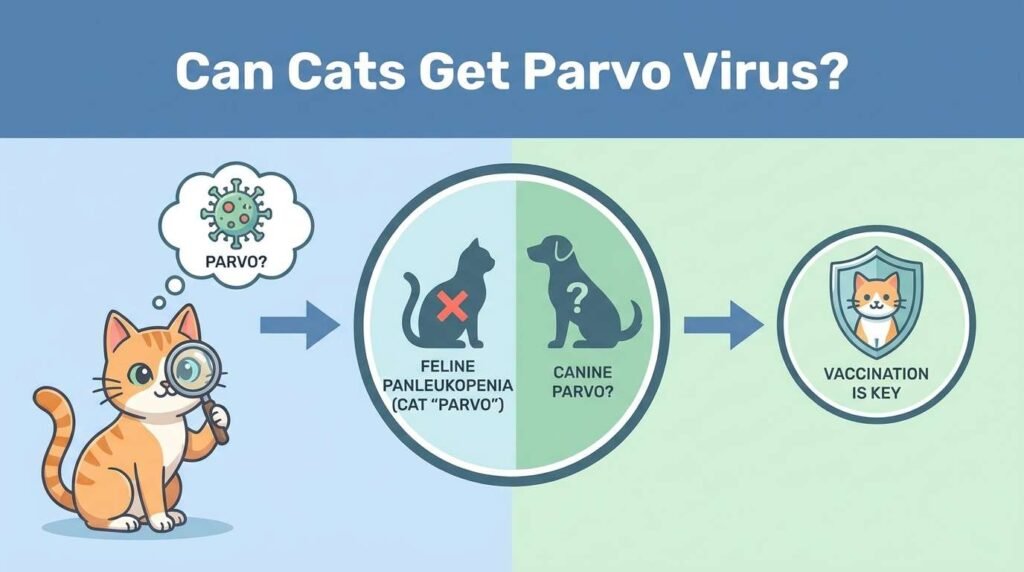
Yes — cats absolutely can get parvo. While most people associate parvovirus with dogs, cats have their own highly contagious and often deadly version called Feline Panleukopenia Virus (FPV), also known as feline parvovirus or cat distemper. In fact, FPV is the original parvovirus from which canine parvovirus (CPV-2) evolved. Understanding this disease could one day save your cat’s life.
Feline panleukopenia (cat parvo) is one of the most dangerous infectious diseases in cats, with a mortality rate of 50–90% in untreated kittens. However, vaccination is highly effective — nearly 100% protective — making prevention straightforward and essential for every cat.
Sources: PubMed (LMU Munich, 244 cats study), NCBI Shenzhen survey 13,134 cats, Vetster, Dispomed
What Exactly Is Feline Parvo (FPV)?
Feline Panleukopenia Virus belongs to the Parvoviridae family and the Protoparvovirus genus — the exact same family as canine parvovirus. It is a small, non-enveloped, single-stranded DNA virus. The word “panleukopenia” literally means a dramatic drop in all white blood cells (pan = all, leuko = white blood cells, penia = deficiency), which is the hallmark of this disease.
FPV is also known by several other names: feline distemper, feline infectious enteritis (FIE), and cat plague. Despite the word “distemper” in the name, it has no relation to canine distemper virus — these are entirely different pathogens. All members of the Felidae family — domestic cats, lions, tigers, leopards, cheetahs, and even pumas — are susceptible.
They are closely related but not identical. Research confirms that canine parvovirus types CPV-2a, CPV-2b, and CPV-2c can cross-infect cats and even cause panleukopenia-like disease. However, FPV cannot infect dogs. The viruses share ~98% genetic similarity but differ in key capsid proteins that determine host range.
How Do Cats Get Parvo? — Transmission Routes
FPV is extraordinarily contagious. The virus is shed in enormous numbers in the feces, urine, vomit, and nasal secretions of infected cats — even before clinical signs appear. What makes this virus particularly dangerous is its environmental resilience.
🔗 How FPV Spreads — Transmission Chain
Cat
Secretions
Surfaces
Hands
Cat Infected
✅ Direct Transmission
- Contact with infected cat’s feces
- Grooming an infected cat
- Contact with infected saliva or urine
- Mother-to-kitten (in utero or nursing)
⚠️ Indirect Transmission
- Contaminated food bowls and water dishes
- Bedding, litter trays, carrier cages
- Human clothing, hands, or shoes
- Floors and surfaces of shelters or catteries
FPV is highly resistant to most common household disinfectants, heat, and cold. Only bleach-based products (sodium hypochlorite), aldehydes, and peracetic acid reliably inactivate it. This means a cat can contract the virus months after an infected animal left a space.
Which Cats Are Most at Risk?
While any unvaccinated cat can contract FPV, certain populations face significantly elevated risk. A 2022–2024 large-scale survey of 13,134 cats in Shenzhen, China found that unvaccinated, under-1-year-old cats had dramatically higher infection rates, with FPV being the most prevalent pathogen in feline populations at 35.83%.
| Risk Category | Risk Level | Reason |
|---|---|---|
| Kittens under 8 weeks | Extremely High | Immature immune system; maternal antibodies waning |
| Kittens 8–16 weeks (unvaccinated) | Very High | Maternal immunity gap before vaccine schedule completes |
| Unvaccinated adult cats | High | No immune protection, susceptible at any age |
| Shelter/cattery cats | High | High density, variable vaccination status, stress |
| Pregnant cats | High | Risk of fetal cerebellar hypoplasia or abortion |
| Immunocompromised cats (FeLV/FIV) | Very High | Suppressed immune response worsens outcome |
| Vaccinated indoor adult cats | Low | Robust vaccine-induced immunity, limited exposure |
Risk assessment based on AVMA, ABCD, and Merck Veterinary Manual guidelines
Symptoms of Cat Parvo — What to Look For
FPV attacks cells that are rapidly dividing — primarily those in the bone marrow, lymph nodes, intestinal lining, and developing fetuses. The incubation period is typically 2–7 days after exposure. Symptoms progress rapidly and can be fatal within 24–48 hours in severe cases.
Day-by-Day Disease Progression
Sudden lethargy, loss of appetite, mild fever (up to 105°F / 40.5°C), hiding behavior. The cat may appear “off” but symptoms aren’t yet alarming.
Severe vomiting (often profuse and repetitive), profuse diarrhea that may become bloody, extreme dehydration. The cat may crouch near the water bowl but refuses to drink.
White blood cell counts plummet (leukopenia). Body temperature may drop below normal (hypothermia). Secondary bacterial infections invade. The cat may develop sepsis.
With intensive veterinary care, cats that survive beyond this point often begin recovering. Cats that recover usually show improvement within 5–7 days. Without treatment, death is common within this window.
In very young kittens, FPV can cause sudden death with virtually no prior symptoms. This is often mistaken for poisoning. It is a recognized presentation of severe FPV.
Complete Symptom Checklist
- Sudden, severe lethargy and weakness
- Complete loss of appetite (anorexia)
- High fever (early) or dangerously low temperature (late)
- Repeated vomiting (often yellow bile)
- Watery to bloody diarrhea
- Severe dehydration (skin tenting, sunken eyes, dry gums)
- Hunching near water bowl without drinking
- Pale or yellowish gums
- In kittens: Sudden death without prior signs
- In neonates or fetuses: Brain damage causing cerebellar ataxia (wobbling, tremors)
How Is Feline Panleukopenia Diagnosed?
Because several conditions mimic FPV (salmonellosis, other viral gastroenteritis, toxin ingestion), laboratory confirmation is important. Your veterinarian will combine clinical findings with diagnostic testing.
| Diagnostic Test | What It Detects | Notes |
|---|---|---|
| Fecal Antigen ELISA / Rapid Test | FPV antigen in stool | Quick, widely available; CPV dog tests may detect FPV too. False negatives possible early in infection. |
| PCR (Polymerase Chain Reaction) | FPV DNA in feces or blood | Gold standard for confirmation; highly sensitive and specific. Distinguishes FPV from CPV-2. |
| Complete Blood Count (CBC) | Leukopenia, thrombocytopenia, anemia | Hallmark finding: white blood cells often below 2,000/μL. Helps gauge severity and prognosis. |
| Serum Chemistry Panel | Organ function, electrolytes | Hypoalbuminemia and hypokalemia are negative prognostic indicators (PubMed 2010 study). |
| Electron Microscopy / Histopathology | Virus particles in tissue | Used in research or post-mortem; not routine clinically. |
| Titer Testing | Circulating FPV antibodies | Useful in adults to assess immunity level; can guide revaccination decisions. |
Diagnostic methods as described in Merck Veterinary Manual and ABCD Feline Panleukopenia Guideline
Treatment: What Vets Do to Save Infected Cats
There is no antiviral drug that directly kills FPV. Treatment is entirely supportive — meaning vets work to keep the cat alive and stable while the immune system fights the virus. Speed of intervention is critical. The earlier treatment begins, the better the outcome.
If your cat shows any combination of: complete refusal to eat, repeated vomiting, bloody diarrhea, extreme lethargy, pale or white gums, or a sudden drop in body temperature — go to an emergency vet clinic now. Do not wait overnight.
| Treatment | Purpose | Details |
|---|---|---|
| IV Fluid Therapy | Combat dehydration & shock | Most critical intervention. Restores fluid balance, corrects electrolyte imbalances (K⁺, Na⁺). Often continued for days. |
| Antiemetics | Control vomiting | Maropitant (Cerenia) or ondansetron. Allows oral medications to be tolerated and prevents further fluid loss. |
| Broad-Spectrum Antibiotics | Prevent secondary infections | Gut bacteria can invade bloodstream through the damaged intestinal wall (bacterial translocation). Ampicillin, enrofloxacin, or metronidazole commonly used. |
| Nutritional Support | Maintain energy & gut healing | Tube feeding or parenteral nutrition if vomiting prevents eating. A-/E-tube placed for prolonged cases. |
| Blood/Plasma Transfusion | Severe anemia or thrombocytopenia | Indicated in cats with very low red blood cells or clotting issues. Also provides passive antibodies. |
| CPMA (Monoclonal Antibody) | Passive immune support | Experimental: A 2024–2025 Charleston Animal Society study explored canine parvovirus monoclonal antibody in cats with promising early results. |
| Isolation & Nursing Care | Prevent spread & support recovery | Strict isolation from other cats. Warm bedding, hygiene, minimal stress. Regular monitoring of temperature and vitals. |
Treatment protocols based on AVMA, Merck Veterinary Manual, and VSL Veterinary Clinic guidelines
Sources: Merck Veterinary Manual, PubMed (LMU Munich study 1990–2007, n=244), Vetster, Vet Verified, ABCD Cats & Vets
Prevention: Vaccination Is the Only Reliable Defense
Vaccination against FPV is classified as a core vaccine — meaning every cat, including indoor-only cats, should receive it. The ABCD (Advisory Board on Cat Diseases) and AVMA both confirm that FPV vaccines provide robust, long-lasting — and likely lifelong — immunity. This is one of the most effective vaccines in all of veterinary medicine.
Recommended Vaccination Schedule
wks
wks
wks
mo
3 yrs
Even strictly indoor cats should be vaccinated because FPV can be tracked in on shoes and clothing. The virus can survive on surfaces for up to a year. The ABCD recommends FPV vaccination for all cats without exception.
Additional Prevention Measures
- Use FPV-effective disinfectants: bleach diluted 1:32, peracetic acid, or glutaraldehyde products
- Isolate any new cat for at least 2 weeks before introducing to resident cats
- Avoid placing unvaccinated kittens in shelters or high-traffic catteries
- Wash hands thoroughly after handling stray or unknown cats
- Change shoes or use dedicated indoor footwear if you work with cats
- Ensure pregnant queens are up-to-date on vaccination before breeding (avoid live vaccines during pregnancy)
- In outbreak settings: re-vaccinate the entire cat population with modified live virus (MLV) vaccine immediately
FPV in Pregnant Cats — A Special Concern
When a pregnant cat contracts FPV, the consequences extend to her unborn kittens. The virus crosses the placental barrier and attacks the rapidly developing cells of fetal brains. This leads to cerebellar hypoplasia — a condition where kittens are born with an underdeveloped cerebellum, resulting in classic “wobbly kitten syndrome” (ataxia, tremors, loss of balance). These kittens often survive but have permanent neurological deficits.
Kittens infected in the first few weeks after birth may also develop cerebellar hypoplasia if FPV invades during early postnatal brain development. Blindness, seizures, and severe developmental delays are also possible outcomes of perinatal infection.
Modified live virus (MLV) FPV vaccines should NOT be given to pregnant queens, as the attenuated virus can also cause cerebellar hypoplasia in fetuses. Killed (inactivated) vaccines are safer during pregnancy. Always consult your vet before vaccinating a pregnant cat.
What the Latest Research Tells Us
| Study | Key Finding | Year |
|---|---|---|
| LMU Munich (PubMed) — 244 cats | Survival rate 51.1%. Leukocyte count at admission was the single strongest predictor of survival. Cats with <1,000/μL WBC had 1.77–1.85× higher risk of death. | 2010 |
| NCBI Shenzhen Survey — 13,134 cats | FPV was the most prevalent pathogen in cats (35.83%). Unvaccinated, under-1-year-old animals had the highest infection risk. Incidence peaked in winter and spring. | 2022–2024 |
| Frontiers Vet. Science — Pallas’s Cats | First documented FPV outbreak in captive Pallas’s cats confirmed FPV’s expanding host range and lethality in non-domestic felids. | 2024 |
| Slovakia Pilot Study — 59 cats | CPV-2 (dog parvo) was detected in cats with panleukopenia clinical signs, confirming cross-species infection and the limitation of commercial CPV tests for FPV diagnosis. | 2024 |
| Charleston Animal Society — CPMA Trial | Canine parvovirus monoclonal antibody (CPMA) was trialed experimentally in shelter cats with FPV. Early results suggested improved live outcomes, though peer-reviewed data is still emerging. | 2024–2025 |
| China FPV Genotype Study (PMC) | Despite routine vaccination, clinical FPV cases continue. Identified FPV-G1 as the predominant genotype in China, with genetic evolution warranting ongoing vaccine surveillance. | 2024 |
Research compiled from PubMed, PMC, Frontiers in Veterinary Science, and Journal of Shelter Medicine
Can Cats Give Parvo to Dogs or Vice Versa?
🐱 → 🐶 Cat to Dog?
FPV cannot infect dogs. The feline parvovirus uses different cell-surface receptors to enter host cells that are not present in canine cells. Your dog is safe from FPV.
🐶 → 🐱 Dog to Cat?
CPV-2 variants (2a, 2b, 2c) can infect cats and cause panleukopenia-like illness. However, this is less common and typically causes milder disease in cats compared to FPV itself.
Frequently Asked Questions
Protect Your Cat — Vaccination Saves Lives
Feline panleukopenia (cat parvo) is one of the most lethal yet most preventable diseases in veterinary medicine. A simple, affordable core vaccine provides robust protection. Whether you have a kitten or an adult cat, indoor-only or outdoor — talk to your vet today about ensuring their FVRCP vaccination is current. It may be the single most important thing you do for their health.