
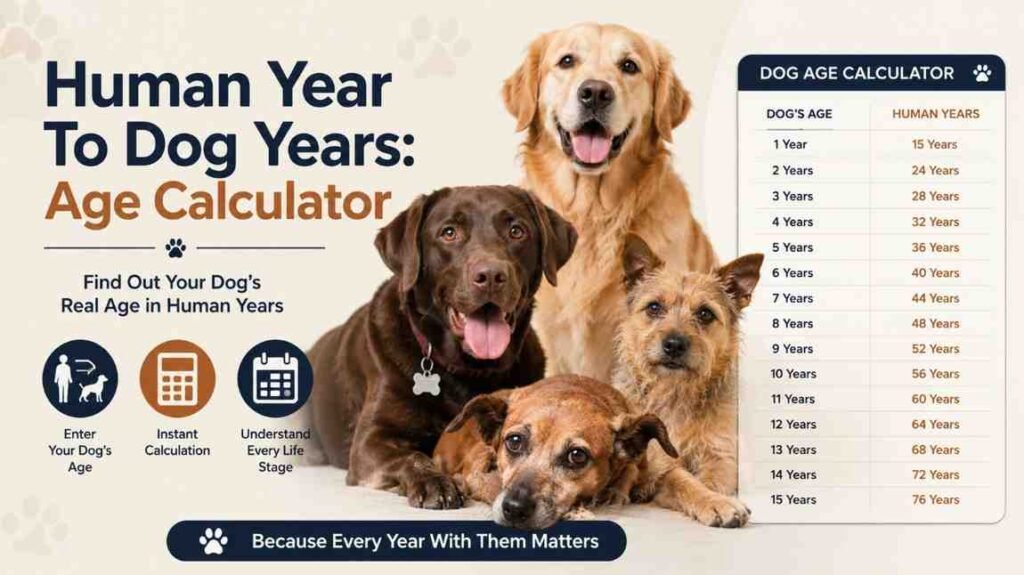
🐕 Dog Age Calculator
Enter details below for instant conversion
How This Calculator Works
Our tool uses peer-reviewed veterinary research (2019 UC San Diego study) to provide accurate conversions. Unlike the outdated “multiply by 7” rule, we account for:
- Non-linear aging: Dogs mature faster in early years
- Breed size: Larger dogs age quicker than small breeds
- Life stages: Different rates for puppies vs. seniors
The Science Behind Dog Aging
The “7 dog years = 1 human year” myth has been debunked by modern science. Researchers analyzed DNA methylation patterns in over 100 Labradors and discovered dogs follow a logarithmic aging curve:
Key Findings:
- Year 1: ≈ 15 human years (rapid development)
- Year 2: +9 years (total: ~24, fully mature)
- Years 3+: +4-7.5 years annually (varies by breed size)
The formula: human_age = 16 × ln(dog_age) + 31. Our calculator simplifies this while maintaining accuracy.
Breed Size Matters
A dog’s adult size dramatically affects aging rate. Here’s why:
🐕 Small Breeds (<20 lbs)
- Examples: Chihuahua, Pomeranian, Yorkie
- Lifespan: 14-18 years
- Aging rate: Slowest (~4x after year 2)
🦮 Medium Breeds (20-50 lbs)
- Examples: Beagle, Cocker Spaniel, Border Collie
- Lifespan: 12-14 years
- Aging rate: Moderate (~4.5x)
🐕🦺 Large Breeds (50-90 lbs)
- Examples: Labrador, German Shepherd, Golden Retriever
- Lifespan: 10-12 years
- Aging rate: Faster (~5.5x)
🐘 Giant Breeds (>90 lbs)
- Examples: Great Dane, Mastiff, Saint Bernard
- Lifespan: 8-10 years
- Aging rate: Fastest (~7.5x)
Age Conversion Chart
Quick reference for all breed sizes:
| Dog Age | Small | Medium | Large | Giant |
|---|---|---|---|---|
| 1 yr | 15 | 15 | 15 | 15 |
| 2 yrs | 24 | 24 | 24 | 24 |
| 3 yrs | 28 | 29 | 31 | 32 |
| 5 yrs | 36 | 39 | 45 | 49 |
| 7 yrs | 44 | 49 | 57 | 66 |
| 10 yrs | 56 | 64 | 75 | 90 |
| 12 yrs | 64 | 74 | 87 | 106 |
| 15 yrs | 76 | 89 | 105 | 130 |
Understanding Life Stages
👶 Puppy/Adolescent (0-24 human years)
Dog age: 0-2 years | Focus on socialization, training, vaccinations, growth nutrition.
🧑 Young Adult (25-40 human years)
Dog age: 3-5 years | Prime time! Maintain weight, establish exercise routines, preventive care.
👨 Middle-Aged (41-60 human years)
Dog age: 6-9 years | Watch for graying, weight gain, decreased stamina. Proactive health management.
👴 Senior (61-75 human years)
Dog age: 10-12 (small/med), 8-10 (large/giant) | Bi-annual vet visits, senior diet, joint care.
🧓 Geriatric (76+ human years)
Dog age: 13+ (small), 11+ (medium), 9+ (large), 7+ (giant) | Comfort-focused care, quality of life assessment.
Caring for Senior Dogs
🏥 Health Monitoring
- Vet visits every 6 months (not just annual)
- Blood work twice yearly
- Dental exams (oral disease causes chronic pain)
- Arthritis screening if mobility decreases
🍖 Nutrition
- Switch to senior food (10-20% fewer calories)
- Maintain high protein (25%+) to prevent muscle loss
- Add joint supplements (glucosamine) with vet approval
- Smaller, frequent meals (3x daily)
🏃 Exercise
- Shorter, gentler walks (15-20 min each)
- Swimming (low-impact on joints)
- Mental stimulation (puzzle toys, gentle training)
- Watch for fatigue signs immediately
🏠 Environment
- Orthopedic bedding (memory foam)
- Ramps/steps (no jumping)
- Non-slip rugs on smooth floors
- Elevated food/water bowls
Debunking Myths
❌ Myth 1: “1 Dog Year = 7 Human Years”
Reality: Originated in 1950s, thoroughly debunked. A 1-year-old dog = 15-year-old teen, not 7-year-old child!
❌ Myth 2: “All Dogs Age the Same”
Reality: By age 10, there’s a 34-year difference between small and giant breeds in “human age.”
❌ Myth 3: “Teeth Reveal Exact Age”
Reality: Only reliable for puppies under 12 months. After that, wear varies too much by diet/genetics.
❌ Myth 4: “Mixed Breeds Age Unpredictably”
Reality: Mixed breeds often live 1-3 years longer due to “hybrid vigor” (genetic diversity).
✅ The Truth
Dog aging is complex and individual. Our calculator provides the best publicly available estimates using validated research.
Frequently Asked Questions
Click any question to reveal the answer.
The gold standard uses breed-size-adjusted formulas from epigenetic research (UC San Diego 2019). Key principles:
- Non-linear aging (first 2 years = ~24 human years total)
- Size-dependent acceleration (larger breeds accumulate “human years” faster)
- Individual variation (genetics, lifestyle, healthcare matter)
Our calculator implements these principles—far more accurate than “multiply by 7.”
Multiple factors contribute:
- Rapid growth: Giant breeds reach adult size in 12-18 months (vs. 24+ for small breeds), causing cellular stress
- Metabolic demands: Maintaining 150 lbs generates more free radicals than maintaining 10 lbs
- IGF-1 hormone: Large breeds produce more growth hormone, linked to accelerated aging/cancer risk
- Mechanical stress: Heavier bodies strain joints, heart, and organs earlier
It varies dramatically by size:
- Small breeds: 11-12 years old (~60-64 human years)
- Medium breeds: 10-11 years (~64-69 human years)
- Large breeds: 8-9 years (~63-69 human years)
- Giant breeds: 6-7 years (~57-66 human years)
“Senior” means shifting toward monitoring age-related conditions—not necessarily declining health.
Honestly? Almost never. Examples of failure:
- Puppies: 1-year-old can reproduce (=15 human years), not 7
- Mid-life: 6-year-old Great Dane is ~57 in human terms, not 42
- Seniors: 12-year-old Chihuahua is ~64, not 84
Verdict: Abandon the myth. Use breed-specific calculators like ours.
Research shows proactive care adds 2-3+ years:
- Nutrition: High-quality food appropriate for life stage, maintain lean weight (obesity shortens lives by up to 2 years)
- Preventive care: Annual/bi-annual exams, vaccinations, dental cleanings, baseline bloodwork
- Exercise: Daily activity tailored to breed/age, mental stimulation (training, puzzles)
- Safety: Secure fencing, toxin-free home, low-stress environment
- Emotional wellbeing: Consistent routine, affection, anxiety management if needed
Yes—by ~1.3 years on average due to “hybrid vigor”:
- Purebreds come from closed gene pools, concentrating both desirable traits AND genetic defects
- Mixed breeds inherit diverse genes, diluting breed-specific disease risks
- 2013 study of 23,000+ dogs found mixed breeds had significantly lower rates of 10 genetic disorders
For our calculator: Classify mixed breeds by adult weight into small/medium/large/giant category.
Watch for these changes:
Physical:
- Graying muzzle (starts 5-7 years)
- Cloudy eyes (normal lenticular sclerosis, not always cataracts)
- Weight fluctuations (gain or loss)
- Stiffness/lameness, especially after rest
Behavioral:
- Increased sleeping, restlessness at night
- Decreased enthusiasm for walks/play
- New anxieties or clinginess
- House-training accidents in previously reliable dogs
Sensory: Hearing loss, vision decline, reduced smell interest
When to worry: Sudden/severe changes need immediate vet evaluation. Gradual changes are normal aging.
No—cats have different aging patterns:
- No size variation: All cats age similarly regardless of breed size (unlike dogs)
- Longer lifespan: Indoor cats often reach 15-20 years (76-96 human years)
- Different senior timeline: Cats become senior around 11-14 years (later than most dogs)
- Unique conditions: Kidney disease, hyperthyroidism patterns differ from dogs
Use a dedicated cat calculator instead.
Based on life stage urgency:
- Puppies (0-2 yrs): Every 1-2 months (they age 15 years in first year alone!)
- Adults (2-7 yrs): Annually on birthday
- Seniors (8+): Every 6 months (aligns with bi-annual vet visits)
Special occasions: After weight changes, before major decisions (treatments, travel plans), updating insurance documents.
Pro tip: Set phone reminders titled “Check Dog’s Human Age” matching your dog’s current stage frequency.
It’s excellent for client education and preliminary assessment, but vets use additional tools:
- Blood panels: Organ function markers reveal physiological age beyond chronological
- Physical exam: Body condition score, joint mobility, dental grade, cardiac auscultation
- Breed risk profiles: Knowledge of predispositions (Goldens → cancer, Dachshunds → IVDD)
- Lifestyle history: Diet, exercise, environment, preventive care compliance
- Imaging: X-rays, ultrasound, echocardiography when indicated
Best use: Helping owners conceptualize life stages, explaining why different-sized dogs need different care timing, educational materials.
Limitation: No calculator replaces hands-on veterinary assessment. Individual dogs vary wildly from averages.
Final Thoughts 🐾
Understanding your dog’s “human age” helps you anticipate needs and cherish each stage. Whether puppy or senior, what matters most is the love and quality care you provide daily.
Share your dog’s calculated age below! 🐕❤️