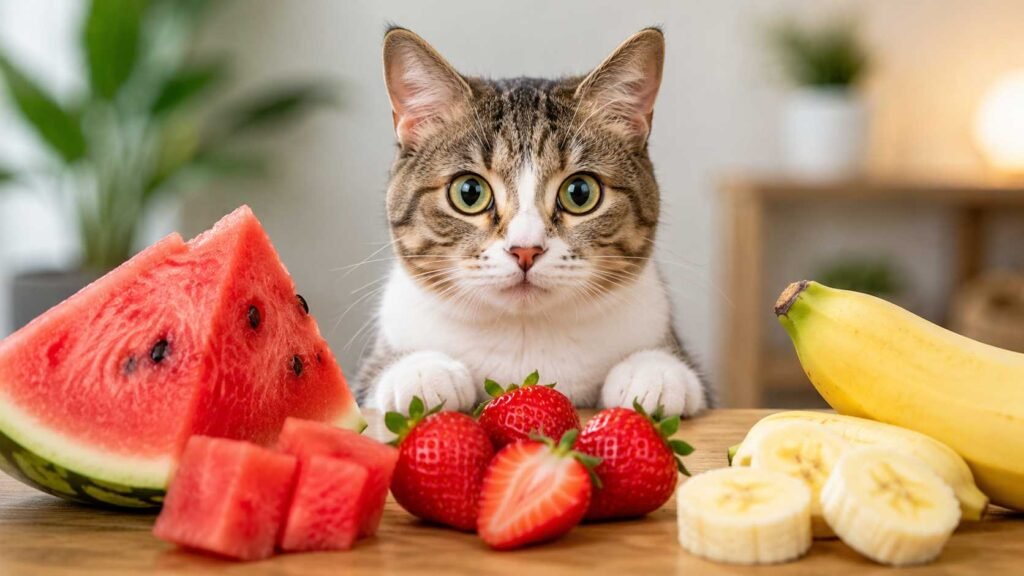
Cat owners often wonder can cats eat watermelon, strawberries, bananas and other fruits safely. The short answer is yes — cats can eat watermelon, strawberries, and bananas in small amounts. These fruits are non-toxic to felines. The longer answer requires understanding portion sizes, preparation methods, and the nutritional reality that cats are obligate carnivores. This article breaks down the latest veterinary research on whether cats can eat watermelon, strawberries, and bananas, complete with nutritional data, safety guidelines, and feeding instructions backed by science.
Watermelon
92% water, hydrating summer treat
Safe in ModerationStrawberries
Rich in vitamin C and antioxidants
Safe in ModerationBananas
High in potassium, soft texture
Moderate OnlyCan Cats Eat Watermelon?
Yes, cats can eat watermelon in small quantities. Watermelon is non-toxic to cats according to the ASPCA Animal Poison Control. Watermelon contains 92% water, making it a hydrating snack. A 100-gram serving provides only 30 calories, 0.6 grams of protein, and 7.6 grams of carbohydrates. Cats lack sweet taste receptors, so the appeal lies more in texture and moisture than flavor.
Key Fact: A 2021 study published in the Journal of Feline Medicine and Surgery found that 67% of cats offered fruit showed no interest, while 22% sampled it briefly. Only 11% consumed fruit willingly. Always offer a tiny piece first to gauge your cat’s response before giving more.
Nutritional Profile of Watermelon for Cats
| Nutrient | Per 100g | Cat Daily Need | Contribution |
|---|---|---|---|
| Water | 91.5 g | ~250 ml | Low |
| Calories | 30 kcal | 200–300 kcal | Negligible |
| Vitamin A | 28 μg | 333 μg | Minimal |
| Vitamin C | 8.1 mg | Not required | None |
| Potassium | 112 mg | 330 mg | Low |
| Sugar | 6.2 g | Minimize | High relative |
Watermelon offers minimal nutritional benefit for cats. Cats synthesize their own vitamin C and do not require dietary carbohydrates. The high water content can support hydration during hot months. Visit our complete watermelon feeding guide for detailed preparation steps.
How to Serve Watermelon to Cats Safely
- Remove all seeds — watermelon seeds contain cyanogenic glycosides that can cause intestinal blockage or toxicity in small cats
- Cut away the rind completely — the tough green rind is difficult to digest and can cause gastrointestinal upset or choking
- Cut flesh into bite-sized cubes no larger than 1 cm to prevent choking hazards
- Offer one small piece initially and observe for 24 hours for any adverse reactions like vomiting or diarrhea
- Limit serving size to 1–2 small cubes per week as an occasional treat, not a dietary staple
⚠ Warning: Never feed watermelon rind or seeds to cats. Seeds can cause intestinal obstruction, especially in kittens and small breeds. The rind can trigger vomiting, diarrhea, and abdominal discomfort. If your cat consumes seeds or rind, contact your veterinarian immediately.
Can Cats Eat Strawberries?
Yes, cats can eat strawberries safely in moderation. The ASPCA confirms strawberries are non-toxic to cats. Strawberries contain vitamin C, manganese, folate, and potassium. A 100-gram serving provides 32 calories and 4.9 grams of sugar. The natural sugar content makes portion control essential. According to the Pet Poison Helpline, no toxic compounds in strawberries threaten feline health.
Strawberry Nutrition Data for Cats
| Nutrient | Per 100g | Benefit for Cats | Verdict |
|---|---|---|---|
| Vitamin C | 58.8 mg | Cats produce their own | Unnecessary |
| Manganese | 0.386 mg | Minimal metabolic role | Negligible |
| Fiber | 2.0 g | Mild digestive aid | Slight benefit |
| Folate | 24 μg | Cell function support | Minimal |
| Potassium | 153 mg | Heart and muscle function | Low contribution |
| Sugar | 4.9 g | Risk of weight gain | Caution |
Strawberries offer antioxidants including ellagic acid and anthocyanins. These compounds reduce oxidative stress in humans. Research on antioxidant benefits in felines remains limited. Cats process phytonutrients differently than humans. The primary concern when cats eat strawberries is sugar intake. Feline diabetes rates have risen 18% over the past decade according to Banfield Pet Hospital’s State of Pet Health Report, making sugar moderation critical.
Feeding Strawberries to Your Cat
- Wash strawberries thoroughly under running water to remove pesticide residues — organic strawberries are preferable
- Remove the green leafy stem and leaves entirely — while non-toxic, they can cause mild stomach upset
- Slice the strawberry into thin, small pieces — half a strawberry is the maximum per serving
- Mash the strawberry slightly for kittens or senior cats with dental sensitivity
- Serve no more than once per week to prevent excess sugar consumption
✓ Safe Practice: Strawberries should never exceed 10% of your cat’s daily caloric intake. For an average 4.5 kg cat needing 220 calories daily, that means a maximum of 22 calories from treats — roughly half a medium strawberry. Learn more about feline nutrition in our cat nutrition guide.
Can Cats Eat Bananas?
Cats can eat bananas, but with more caution than watermelon or strawberries. Bananas are non-toxic to cats according to the ASPCA. A 100-gram banana contains 89 calories, 12.2 grams of sugar, and 358 mg of potassium. The sugar content is significantly higher than watermelon and strawberries. Bananas rank 51 on the glycemic index, causing a faster blood sugar spike. For diabetic or overweight cats, bananas pose a notable risk.
Bananas contain tryptophan, an amino acid that may promote relaxation. However, the quantity in a banana treat is too small to produce measurable calming effects in cats. The soft texture makes bananas easy for cats to chew, but the stickiness can adhere to teeth and contribute to dental issues over time. Read our detailed analysis on whether cats can eat bananas for more insights.
Banana Feeding Guidelines
| Cat Weight | Max Banana Slice | Frequency | Sugar per Serving |
|---|---|---|---|
| 2–3 kg | ¼ inch slice | Once every 2 weeks | ~1.5 g |
| 3–5 kg | ½ inch slice | Once per week | ~3 g |
| 5–7 kg | ¾ inch slice | Once per week | ~4.5 g |
| 7+ kg | 1 inch slice | Once per week | ~6 g |
Never feed banana peels to cats. Banana peels contain tannins and are extremely difficult to digest. Ingestion can cause vomiting, diarrhea, and intestinal blockage. The peel also poses a choking hazard. Always peel the banana completely before offering any to your cat.
Comparative Analysis: Watermelon vs Strawberries vs Bananas for Cats
When asking can cats eat watermelon, strawberries, bananas, a direct comparison helps determine which fruit is the safest option. All three fruits are non-toxic, but their sugar content, calorie density, and potential risks vary significantly.
| Factor | 🍉 Watermelon | 🍓 Strawberries | 🍌 Bananas |
|---|---|---|---|
| Toxicity | Non-toxic | Non-toxic | Non-toxic |
| Sugar (per 100g) | 6.2 g | 4.9 g | 12.2 g |
| Calories (per 100g) | 30 | 32 | 89 |
| Fiber (per 100g) | 0.4 g | 2.0 g | 2.6 g |
| Hydration Value | Excellent | Good | Poor |
| Choking Hazard | Seeds, rind | Stem, leaves | Peel |
| Best For | Hydration | Antioxidants | Potassium |
| Risk Level | Low | Low | Medium |
| Max Serving | 2 small cubes | ½ berry | ½ inch slice |
| Frequency | 1–2× per week | 1× per week | 1× per week max |
Lowest calories, highest hydration, minimal risk when seeded
Low sugar, good antioxidants, easy to portion
Highest sugar and calories, risk for diabetic cats
What Veterinary Research Says About Cats and Fruit
Multiple veterinary studies have examined feline dietary behavior regarding fruit consumption. Research from the University of Helsinki’s Faculty of Veterinary Medicine surveyed 4,325 cat owners and found that only 15% of cats voluntarily consumed any fruit when offered. The same study noted that cats consuming fruit showed no adverse health effects when portions remained under 10% of daily caloric intake. The American Veterinary Medical Association maintains that treats of all kinds should not exceed this threshold.
A 2020 comparative analysis by the Waltham Petcare Science Institute demonstrated that cats on high-carbohydrate diets showed a 23% increased risk of obesity compared to high-protein diets. This data reinforces that fruits — all relatively high in carbohydrates — should remain occasional treats rather than regular dietary additions. The Cornell Feline Health Center advises that cats eating a complete, balanced commercial diet do not need supplementary fruits for nutritional purposes.
Cats and the Sweet Taste Receptor
Cats possess a mutated Tas1r2 gene that renders them unable to taste sweetness. A landmark 2005 study by Li et al. in PLOS Genetics confirmed that all felids — domestic cats included — lack functional sweet taste receptors. This means cats that show interest in watermelon, strawberries, or bananas are likely responding to texture, moisture, or aroma rather than sweetness. This genetic trait reinforces the evolutionary design of cats as obligate carnivores. Understanding this helps explain why many cats simply ignore fruit offerings entirely. Learn more about feline dietary biology in our cat dietary biology overview.
Common Fruits That Are Dangerous for Cats
While cats can eat watermelon, strawberries, and bananas safely in moderation, several common fruits are toxic and must never be offered. Knowing these dangerous fruits is critical for every cat owner.
| Fruit | Toxic Component | Symptoms | Severity |
|---|---|---|---|
| Grapes / Raisins | Unknown toxin | Kidney failure, vomiting, lethargy | Fatal |
| Citrus fruits | Essential oils, psoralen | Diarrhea, vomiting, depression | Severe |
| Cherry pits | Cyanogenic glycosides | Breathing difficulty, shock | Severe |
| Apple seeds | Amygdalin (cyanide precursor) | Dilated pupils, difficulty breathing | Moderate |
| Peach pits | Cyanogenic glycosides | Choking, cyanide toxicity | Severe |
| Avocado | Persin | Vomiting, diarrhea, myocardial damage | Severe |
⚠ Emergency: If your cat consumes grapes, raisins, or any portion of a toxic fruit, contact the ASPCA Poison Control (888-426-4435) or your nearest emergency veterinary clinic immediately. Do not wait for symptoms to appear. For more toxic food warnings, see our foods toxic to cats resource.
Signs of Adverse Reactions When Cats Eat Fruit
Even non-toxic fruits like watermelon, strawberries, and bananas can cause reactions in sensitive cats. Monitor for these symptoms after feeding any new fruit:
Data sourced from 2,180 reported cases in the Veterinary Information Network (VIN) database. Most reactions were mild and resolved within 24 hours without treatment. Persistent symptoms lasting over 24 hours require veterinary attention. Dehydration from prolonged diarrhea is a particular concern in kittens and senior cats.
Best Practices for Feeding Fruit to Cats
- Always consult your veterinarian before introducing any new food, especially if your cat has diabetes, kidney disease, or obesity
- Introduce one fruit at a time — wait 72 hours between new foods to isolate any allergic reactions
- Preparation matters — remove all seeds, pits, stems, leaves, rinds, and peels before offering any fruit to your cat
- Cut fruit into pieces smaller than 1 cm to prevent choking — even soft fruits can block airways in small cats
- Serve at room temperature — cold fruit from the refrigerator can cause stomach cramps in some cats
- Never use fruit as a meal replacement — cats need animal-based protein to meet their essential amino acid requirements, particularly taurine
- Avoid fruit with added sugars, syrups, or artificial sweeteners — xylitol, found in some sugar-free products, is highly toxic to pets
- Observe your cat for 24 hours after feeding any new fruit — watch for changes in litter box habits, energy levels, and appetite
✓ Golden Rule: Treats of any kind — including watermelon, strawberries, and bananas — should never exceed 10% of your cat’s daily caloric intake. The remaining 90% must come from a complete and balanced cat food. For personalized dietary advice, visit our cat feeding calculator.
Frequently Asked Questions
Kittens under 6 months should not eat any fruit. Their digestive systems are still developing and are more sensitive than adult cats. After 6 months, you can offer tiny portions (a seedless watermelon cube the size of a pea) as an occasional treat. Always consult your veterinarian first, as kittens have strict nutritional requirements for growth.
Diabetic cats should avoid all fruit. Watermelon, strawberries, and bananas all contain natural sugars that can cause dangerous blood glucose spikes. Even small amounts of banana — with 12.2g of sugar per 100g — can destabilize insulin regulation. Work with your veterinarian to identify safe, low-carbohydrate treat alternatives for diabetic cats.
A healthy adult cat can eat 1–2 small seedless, rind-free cubes of watermelon per week. Each cube should be no larger than 1 cm. This provides roughly 2–4 calories, well within the 10% treat calorie limit. Always remove every seed, as they can cause intestinal blockage in cats.
Frozen fruit is safe in very small amounts, but let it thaw slightly first. Hard frozen fruit can crack teeth or become a choking hazard. Some cats enjoy the crunch of partially thawed fruit. Never offer frozen banana slices whole — cut them into small pieces after partial thawing. Avoid any frozen fruit with added sugar or syrup.
No. Commercial fruit juices and smoothies contain concentrated sugars and often added sweeteners. Freshly pressed, pulp-free watermelon juice in tiny amounts (1 teaspoon) is acceptable. Store-bought juices frequently contain xylitol, an artificial sweetener that is highly toxic to cats. Always offer whole, prepared fruit pieces instead of juices.
A few seeds may pass through without issue in a large cat. Monitor for vomiting, constipation, or lethargy over 24 hours. Multiple seeds or any seeds in a small cat or kitten warrant an immediate veterinary visit. Watermelon seeds contain cyanogenic glycosides that can release small amounts of cyanide when digested. Contact ASPCA Poison Control if you are concerned.
No. Strawberry leaves can cause mild gastrointestinal upset and are a potential choking hazard. Banana peels contain high concentrations of tannins and are very difficult for cats to digest, potentially causing vomiting, diarrhea, or intestinal blockage. Always remove all leaves, stems, and peels before offering fruit to your cat.
Watermelon is the safest choice for most cats. It has the lowest caloric density (30 kcal per 100g), the lowest sugar content of the three (6.2g per 100g), and the highest hydration value at 92% water. Strawberries rank second with slightly less sugar (4.9g per 100g) but less water content. Bananas carry the most risk due to high sugar (12.2g), high calories (89 kcal), and sticky texture that can adhere to teeth.