
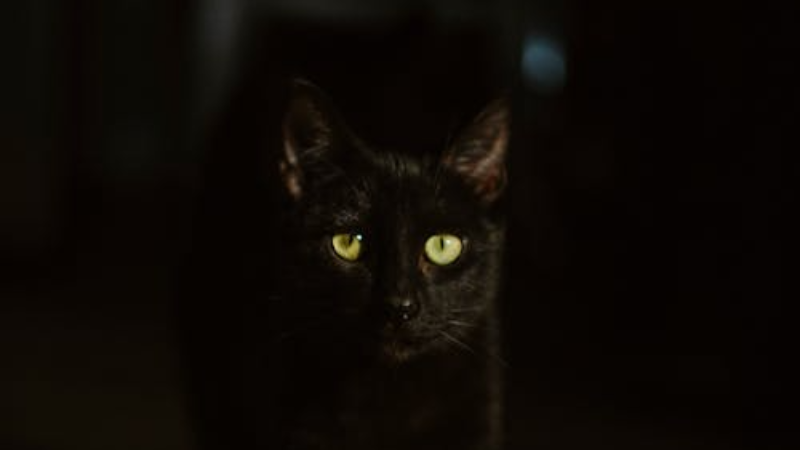
If you have ever watched your cat navigate a pitch-black hallway without bumping into a single piece of furniture, you have witnessed one of the most refined optical systems in the animal kingdom. The question — can cats see in the dark — comes up constantly among pet owners, and the answer is a nuanced yes. Cats possess extraordinary night vision, built over millions of years of crepuscular hunting. While no living eye can see in absolute darkness, feline eyes require only a fraction of the light that human eyes need to form a clear image.
Research consistently shows that cats see in the dark far more effectively than we do. A landmark behavioral study from the University of Illinois confirmed that cats detect contrast at roughly 6.2 times human sensitivity under dim-light conditions — the scientific backbone behind the popular claim that cat night vision is six to eight times sharper than ours. Understanding the biology behind this superpower helps you become a more informed, empathetic cat owner.
The Anatomy Behind Cat Night Vision
Cat night vision is not magic — it is anatomy. Four distinct structural features work in concert to turn a dim environment into a navigable landscape. Each adaptation evolved to solve a specific optical challenge that comes with hunting in low-light conditions.
- 1Tapetum Lucidum — The Natural MirrorPositioned just behind the retina, the tapetum lucidum is a reflective tissue layer unique to cats and several other nocturnal animals. When a photon of light passes through the retina without being absorbed, the tapetum bounces it back for a second pass — essentially doubling the eye’s chance of detecting that photon. This is also why cats’ eyes produce that iconic eye shine in flash photographs.
- 2Rod-Dense Retina — Extreme Light SensitivityCats pack rod photoreceptors at a peak density of approximately 460,000 per square millimeter — roughly three times the human peak of ~160,000. Rods are highly sensitive to dim light and motion but do not process color. This density means a cat’s retina can register individual photons, making faint shapes and movement visible even when humans see only blackness.
- 3Slit Pupils — A Variable ApertureUnlike round human pupils, cats possess elliptical, slit-shaped pupils that can dilate by a factor of 135, versus only 15-fold in humans. In near-darkness the slit opens almost fully, flooding the retina with as much available light as possible. In bright daylight the same slit compresses to a thin line, protecting the sensitive retina without sacrificing depth of focus.
- 4Large Corneas — A Wider Light FunnelAccording to Hill’s Pet, cats’ corneas and pupils are about 50% larger relative to eye size than human corneas. A larger cornea acts like a wider camera lens, gathering more ambient light before it even reaches the retina.
The tapetum lucidum (glowing ring) reflects unabsorbed photons back through the retina for a second absorption pass.
Cat Vision vs Human Vision: A Data Comparison
Understanding how cats see in the dark is easiest when compared directly to human vision. The two species are optimized for entirely different niches — cats for crepuscular predation, humans for daytime color recognition and fine detail.
| Visual Feature | Cat | Human | Advantage |
|---|---|---|---|
| Light needed to see | 1/6 of human requirement | Baseline | Cat 🐱 |
| Rod cells (low-light) | 460,000 / mm² | ~160,000 / mm² | Cat 🐱 |
| Cone cells (color) | ~1× (fewer) | ~10× more than cat | Human 🧑 |
| Pupil dilation | 135-fold | 15-fold | Cat 🐱 |
| Tapetum lucidum | ✅ Present | ❌ Absent | Cat 🐱 |
| Field of view | ~200° | ~180° | Cat 🐱 |
| Visual acuity | 20/100–20/200 | 20/20 | Human 🧑 |
| Daytime motion detection | Weaker | 10–12× better than cat | Human 🧑 |
| UV light transmission | ✅ Lens passes UV | ❌ Lens blocks UV | Cat 🐱 |
| Color spectrum | Dichromat (blues, greens) | Trichromat (full spectrum) | Human 🧑 |
— Veterinary ophthalmologist quoted in Live Science
What Does a Cat Actually See in the Dark?
Cat dark vision prioritizes motion detection over sharpness. In low-light environments, cats perceive movement with remarkable precision — a crucial survival tool for a predator that must track fast-moving prey. However, the trade-off is that their overall visual acuity is significantly lower than ours. While a healthy human sees clearly at 20/20, cat visual acuity typically ranges from 20/100 to 20/200, meaning what you see clearly from 100 feet away, a cat needs to be within 20 feet to resolve.
Color perception is another notable difference. Cats are dichromats with cone cells peaking around 450nm (blue) and 555nm (green). They see blues and some greens, but reds appear as grayish-brown, and the overall color saturation is roughly half of what humans perceive. Think of it as similar to the vision of a person with red-green color blindness — the world is not black and white, but it is considerably less vivid.
- Rod cells (~96%) — Night & motion
- Cone cells (~4%) — Daylight & color
- Cat retina rod-to-cone ratio ≈ 25:1
vs. human ~4:1 (more balanced)
Other Senses That Support Feline Night Navigation
Cat night vision does not operate in isolation. When cats navigate darkness, they engage a full sensory system working in parallel. Even in situations where available light is too low for their eyes to form a usable image, these complementary senses keep them safe and effective.
- Embedded nerve endings detect airflow changes and vibrations
- Span approximately the cat’s shoulder width — a built-in doorway gauge
- Detect obstacle presence without any light at all
- Provide spatial mapping in total darkness
- Cats hear frequencies up to 64,000 Hz (humans max at ~20,000 Hz)
- Can rotate ears 180° independently to locate sounds
- Pinpoints the source of a sound to within 3 inches at 3 feet
- Compensates for visual gaps in complete darkness
- 14× more olfactory receptors than humans
- Detects territory markers, prey trails, and familiar scents in darkness
- Vomeronasal organ processes chemical cues beyond standard smell
- Highly sensitive paw pads feel substrate texture and vibration
- Inner ear balance system allows righting reflex during dark jumps
- Muscle memory maps familiar home layouts
When Does Cat Night Vision Fail?
Despite all its advantages, cat vision in the dark has real limits. Total, complete darkness — zero photons — renders a cat just as blind as any other animal. Their system requires at least some ambient light, however faint. A room with blackout curtains on a moonless night can genuinely impair a cat’s ability to navigate by sight alone.
| Condition | Cat Vision Status | Human Vision Status | Notes |
|---|---|---|---|
| Bright daylight | Moderate | Excellent | Pupil constricts; less sharp color |
| Dim indoor light | Excellent | Reduced | Cat has clear 6–8× advantage |
| Moonlit night | Very Good | Poor | Tapetum amplifies even moonlight |
| Deep twilight / dusk | Optimal | Fair | Cat eye built for this exact range |
| Complete blackout | Blind | Blind | Both species need some photons |
Age and health also affect how well cats see in the dark. Senior cats often develop lenticular sclerosis (a clouding of the lens) or other health issues that reduce light transmission, noticeably diminishing their once-impressive night vision. Conditions like hypertension — common in older cats — can cause retinal detachment, destroying their low-light sensitivity almost entirely.
Practical Tips for Cat Owners Based on Night Vision Science
Knowing how your cat sees in the dark lets you make smarter choices about their environment, safety, and wellbeing. A few evidence-based adjustments can meaningfully improve their quality of life — especially for older cats whose feline night vision has declined.
- Use a low-level night light in unfamiliar spaces — even tiny amounts help
- Keep litter boxes, food, and water in consistent locations
- Schedule vet eye exams annually after age 7
- Provide window access for natural ambient light at dusk and dawn
- Use preventive care to manage blood pressure and conditions that damage the retina
- Shining bright flashlights directly in their eyes — the tapetum makes this painful
- Rearranging furniture frequently if your cat has vision impairment
- Keeping cats in completely blacked-out rooms at night
- Ignoring sudden changes in nighttime navigation behavior
- Assuming any vision loss is normal aging without a vet assessment
5 Surprising Facts About Cat Dark Vision
Beyond the core anatomy, cats’ relationship with light and darkness contains some genuinely surprising biology that even experienced cat owners often do not know.
| # | Fact | Why It Matters |
|---|---|---|
| 01 | Cats can see UV light that human lenses block | They may see hidden urine trails, prey markings invisible to us |
| 02 | Kittens are born with eyes sealed shut for 8–12 days | Night vision matures fully only after several months |
| 03 | Scientists used cat eyes to design advanced artificial vision systems | Published in Science Advances (2024) — feline optics inspire real robotics |
| 04 | Cat flicker fusion rate is 70–80 Hz vs human 16–20 Hz | Cats perceive motion as far smoother and faster than humans do |
| 05 | Vertically slit pupils help shorter animals judge prey distance | UC Berkeley research found slit pupils offer superior depth estimation at ground level |



I liked the distinction that cats can’t see in absolute darkness, but can make use of much lower light levels than humans thanks to their rod-rich eyes and other adaptations. The point about cats being crepuscular also helps explain why so many of them seem most active at dawn and dusk—it’s a good reminder that their behavior is closely tied to how their vision evolved.