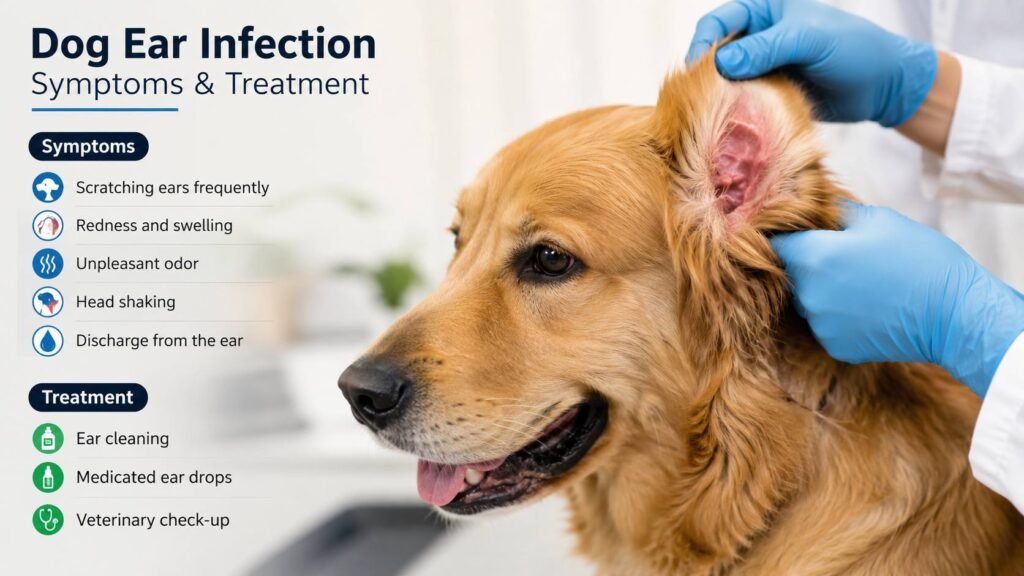
Dog ear infections — medically termed otitis — affect up to 1 in 7 dogs seen in veterinary practice. They rank among the most frequently diagnosed conditions in small animal medicine, yet many cases go undetected until the pain becomes severe. Early recognition of symptoms and prompt treatment prevents permanent hearing damage and costly surgical interventions. According to Merck Animal Health, ear infections account for approximately 5% of all canine veterinary consultations globally each year.
The canine ear has three anatomically distinct segments, each capable of developing infection. According to Veterinary Partner (VIN), the ear canal forms an “L-shape” with both vertical and horizontal parts — a unique anatomy that makes self-cleaning difficult and traps debris. Understanding which part is infected determines treatment urgency and medication choice.
👂
Otitis Externa
Most Common
Affects the outer ear canal
Accounts for 84.6% of cases
Visible redness & discharge
Highly treatable with drops
Can recur without root-cause fix
🦻
Otitis Media
Moderate Risk
Middle ear — behind the eardrum
Often spreads from externa
Near balance-controlling nerves
May trap pus inside
Requires oral medication
🧠
Otitis Interna
Severe — Emergency
Inner ear infection
Causes vestibular dysfunction
Head tilt, loss of balance
Possible permanent hearing loss
Immediate vet care required
Symptoms of Dog Ear Infections
Symptoms range from subtle behavioral changes to acute neurological signs. As noted by PetMD’s veterinary team, dogs rarely vocalize chronic ear pain — meaning behavioral cues are often the only early warning. The cards below classify each sign by clinical severity.
🤚
Head Shaking
Persistent, forceful shaking to relieve discomfort. Can rupture ear blood vessels, causing a secondary aural hematoma.
Moderate
🐾
Pawing / Scratching
Dog rubs ear against furniture or repeatedly paws at it. Self-trauma worsens infection and causes open skin wounds.
Moderate
🔴
Redness & Swelling
Erythema of the ear canal lining — often the first visible sign. Swelling can progress to canal stenosis in chronic cases.
Early Sign
💧
Discharge
Brown/black wax = yeast. Yellow/green pus = bacterial. Bloody discharge signals severe damage — see a vet urgently.
Key Indicator
👃
Foul Odor
A musty, yeasty, or distinctly unpleasant smell from the ear canal. A reliable early warning sign of active Malassezia overgrowth.
Early Sign
😣
Pain on Touch
Dog flinches, yelps, or becomes aggressive when ears are touched. Head-shyness around strangers is a common behavioral signal.
Moderate
↩️
Head Tilt
Persistent tilt toward the infected ear signals otitis media or interna — a vestibular emergency requiring immediate care.
Severe
🔇
Hearing Loss
Dog stops responding to sounds or their name. Indicates deep-seated infection impacting the middle or inner ear structures.
Severe
🚨
Emergency Signs — See a Vet Within 24 Hours
Sudden head tilt, loss of balance, circling, falling to one side, uncontrolled eye movement (nystagmus), or complete hearing loss are neurological red flags. These indicate inner ear infection and require immediate veterinary intervention to prevent permanent damage. Learn more at AVMA Pet Care.
What Causes Dog Ear Infections?
Ear infections in dogs rarely have a single cause. The pathophysiology involves a cascade of predisposing, primary, secondary, and perpetuating factors. Treating only the active infection — without identifying the root cause — virtually guarantees recurrence. A 2024 study published in the International Journal of Advanced Biochemistry Research found that among 651 dogs with visible symptoms, 14.13% were confirmed positive for otitis externa.
Source: Epidemiological Analysis, Northwest China (n=221 dogs)
The most common primary pathogen is Malassezia pachydermatis (yeast), followed by bacterial species including Pseudomonas aeruginosa, Staphylococcus aureus, and Proteus mirabilis. Mixed infections involving both bacteria and yeast are common in chronic cases and require combination therapy for resolution, as detailed in this peer-reviewed review in Veterinary Sciences (2022).
A landmark UK VetCompass Programme study (2021) of 905,554 dogs confirmed that breed and ear conformation are the two strongest risk factors for otitis externa. Dogs with pendulous ears had 1.76× higher odds; those with V-shaped drop ears had 1.84× higher odds compared to erect-eared breeds. The RVC VetCompass team notes that many owners are unaware of how much their dogs suffer from chronic ear pain.
Breed Risk: Odds Ratio for Otitis Externa vs. Crossbred Dogs
Designer breed types overall had 1.63× higher odds of otitis externa compared to crossbred dogs, primarily due to pendant, hair-filled ear canals that trap moisture and restrict airflow. The AVMA reports that pendulous-eared breeds have an otitis incidence of 13–14%, compared to just 5% in erect-eared breeds.
How Veterinarians Diagnose Ear Infections
Accurate diagnosis requires more than a visual inspection. As Dr. Kelly Hood, DVM states via American Kennel Club, vets diagnose by “history, otoscopic exam, and ear cytology.” This three-part protocol distinguishes bacterial from yeast infections — and verifies whether the tympanic membrane is intact before any prescription is written.
Diagnostic Step
Purpose
Findings
History Taking
Duration, prior episodes, allergies, swimming frequency
Identifies recurrence pattern & risk factors
Visual Inspection
Examine both ears for asymmetry, redness, odor
Erythema, discharge type, hair loss
Otoscopic Exam
Visualize canal depth & tympanic membrane
Canal stenosis, foreign body, eardrum integrity
Ear Cytology
Swab sample stained & microscopically examined
Differentiates bacteria vs. yeast — gold standard
Culture & Sensitivity
Grow bacteria to identify species & antibiotic resistance
Used for chronic or treatment-resistant cases
Allergy Testing
Intradermal or serum IgE testing for recurrent cases
Reveals environmental or food allergen triggers
🔬
Cytology is the Gold Standard
Ear cytology is the most efficient method for identifying Malassezia pachydermatis, per Scielo veterinary research. It directly changes the treatment protocol — yeast infections require antifungals, not antibiotics. Treating a yeast infection with antibiotics alone disrupts the bacterial balance and worsens the condition.
Treatment of Dog Ear Infections
Treatment is guided by infection type, depth, and underlying cause. Most uncomplicated otitis externa cases resolve within 1–2 weeks with proper veterinary-prescribed therapy. Chronic or recurrent infections require management of the primary cause. For proper ear cleaning technique guidance, Cornell University’s Riney Canine Health Center offers a detailed owner resource.
1
Professional Ear Cleaning
Vets flush the ear canal with a medicated cleanser to remove discharge, debris, and biofilm before topical medication is applied. Never attempt deep cleaning at home — this can rupture the eardrum. See Cornell’s ear cleaning guide.
2
Topical Medications (Ear Drops)
Antimicrobial drops combining antibiotics, antifungals, and steroids are the primary treatment. Applied daily for 7–14 days. DuOtic (Terbinafine + Betamethasone) — FDA-approved in March 2024 — is a single-use gel lasting up to 45 days for yeast infections.
3
Oral Medications for Severe Cases
Systemic antibiotics (e.g., amoxicillin-clavulanate), antifungals (fluconazole), or corticosteroids are prescribed when otitis media or interna is involved, or when topical therapy fails after 14 days of proper use.
4
Pain Management
NSAIDs (e.g., carprofen, meloxicam) are used short-term to control ear pain and inflammation. These are prescription medications — never use human NSAIDs such as ibuprofen in dogs, as they are toxic at low doses.
5
Addressing the Root Cause
Recurrent infections require treating the primary driver. Atopic dermatitis management using diet trials, immunotherapy, or oclacitinib (Apoquel) is the most impactful intervention for allergy-driven chronic otitis.
6
Surgery (Chronic Obstructive Cases)
Lateral ear canal resection or Total Ear Canal Ablation (TECA) is reserved for severe, irreversible canal stenosis. A 2022 review in Veterinary Sciences highlighted CO₂ laser use in chronic obstructive otitis as an emerging surgical technique.
🔑 Key Takeaway: Never Use Antibiotics Without Cytology
A 2022 review in Veterinary Sciences emphasizes that indiscriminate antibiotic use in otitis cases has driven antimicrobial resistance — particularly in Pseudomonas aeruginosa. Ear cytology before prescribing is not optional; it is clinically essential to match the drug to the pathogen and avoid treatment failure.
Ear Infection Type Comparison — At a Glance
Feature
Otitis Externa
Otitis Media
Otitis Interna
Location
Outer ear canal
Middle ear
Inner ear
Prevalence
Very Common
Less Common
Rare
Key Symptom
Discharge, redness, odor
Head shaking, pain
Head tilt, loss of balance
Hearing Impact
Mild if untreated
Moderate to significant
Potential permanent loss
Treatment
Topical drops + cleaning
Topical + oral meds
Hospitalization, IV meds
Recovery Time
1–2 weeks
2–6 weeks
Weeks to months
Risk if Untreated
Canal damage
Hearing loss
Permanent neurological damage
Prevention: How to Reduce Recurrence
Chronic ear infections are preventable in most dogs. The key is consistent ear hygiene paired with managing the predisposing condition — most commonly allergies. According to Healthline’s veterinary-reviewed guide, routine ear cleansing is especially important for dogs that swim or have floppy ears.
🐾 Veterinarian-Recommended Prevention Checklist
✅
Weekly ear inspection: Check for redness, odor, or discharge every 7 days. Early detection prevents escalation.
✅
Dry ears after swimming: Use a cotton ball — never a cotton swab — to gently absorb moisture from the outer canal. Water is the primary trigger of yeast overgrowth. See Cornell’s ear care resource.
✅
Vet-approved ear cleanser: Use a pH-balanced solution 1–2× monthly in high-risk dogs. Avoid hydrogen peroxide, alcohol, or vinegar — these irritate the canal lining and disrupt normal flora.
✅
Manage underlying allergies: Food trials (novel protein diet for 8–12 weeks) and environmental allergen control directly reduce allergic otitis frequency.
✅
Trim excess ear canal hair: In poodles, terriers, and labradoodles, dense canal hair traps debris and heat. Professional grooming every 6–8 weeks maintains healthy airflow.
✅
Schedule recheck visits: A 2–3 week follow-up cytology after treatment confirms clearance, preventing treatment-resistant strains from developing — especially Pseudomonas biofilms.
📊
Research Update: Blue Light & Market Growth
The global companion animal ear infection treatment market was valued at $713.52 million in 2024 and is projected to grow at 8.11% CAGR through 2030, per Grand View Research. Simultaneously, researchers at the University of Birmingham showed specific blue light frequencies can kill 99% of bacteria linked to canine ear infections — a therapy under active clinical development.
Trusted Veterinary Resources
For further reading, these peer-reviewed and institution-backed sources were used in preparing this article:
Over-the-counter medicated ear cleansers can help very mild early-stage infections. However, without cytology, you cannot determine whether the cause is bacterial or yeast — and using the wrong treatment worsens the infection. Most significant ear infections require prescription medication. Always consult a veterinarian before treating at home. PetMD notes there are no effective home remedies for significant infections.
With proper veterinary treatment, most uncomplicated otitis externa infections clear within 1–2 weeks. Otitis media may require 2–6 weeks of systemic medication. Chronic or recurrent infections can take months to control if the underlying cause — such as allergies or hypothyroidism — is not addressed simultaneously. A recheck cytology at 2–3 weeks confirms resolution.
Most bacterial and yeast ear infections in dogs are not contagious to humans. Ear mites (Otodectes cynotis), however, are highly contagious between dogs and cats sharing a household. If one pet is diagnosed with ear mites, all household pets should be treated simultaneously to prevent reinfection.
A healthy dog ear has very minimal, light-colored wax with no odor. Dark brown or black crumbly discharge suggests ear mites or yeast. Tan to yellow-brown waxy discharge is typically a yeast infection. Green or yellow pus-like discharge signals a bacterial infection. Any bloody discharge warrants immediate veterinary attention.
Recurring infections almost always point to an unresolved primary cause. Atopic dermatitis or food allergy accounts for the majority of chronic cases. Hormonal disorders such as hypothyroidism, anatomical abnormalities like narrow canals, and incomplete prior treatment also contribute significantly. Dogs with 3+ infections per year need full allergy evaluation.
Yes. Food allergies are a major predisposing factor for chronic otitis externa. Dogs develop immune-mediated reactions to dietary proteins — most commonly chicken, beef, dairy, and wheat — that alter the ear canal microenvironment, promoting yeast and bacterial overgrowth. An 8–12 week novel protein or hydrolyzed protein diet trial is the standard diagnostic approach recommended by veterinary dermatologists.
DuOtic (terbinafine + betamethasone) was FDA-approved in March 2024 as the first long-acting gel specifically for yeast ear infections in dogs. Unlike daily drops, it is applied in two vet-administered doses one week apart, then slowly dissolves into earwax over 45 days. The ear canal should not be cleaned for 45 days after application. It is available by prescription only.
Untreated otitis externa spreads to the middle ear (otitis media), causing significant pain, partial hearing loss, and eardrum rupture. Infection reaching the inner ear causes vestibular dysfunction — head tilt, loss of balance, and circling — and can result in permanent hearing loss. In the most severe cases, infection spreads to surrounding tissue, causing facial nerve paralysis or meningitis. Veterinary Partner (VIN) notes that pus from ear infections can become permanently trapped in the middle ear if treatment is delayed.
Medical Disclaimer: This article is written for educational purposes only and is based on peer-reviewed veterinary research, published clinical studies, and FDA-approved guidelines. It does not replace professional veterinary advice, diagnosis, or treatment. If you suspect your dog has an ear infection, consult a licensed veterinarian promptly.